Table Of Content
- Kings Bay Naval Submarine Base
- Browse our Suppliers and their Products & Services
- Everything To Know About Tomahawk Missiles: Speed, Cost, And Destructive Power
- Demand exploding for Tomahawk missiles as US backs latest foreign sale
- The Tomahawk's combat history
- Here Is What Each Of The Navy’s Ship-Launched Missiles Actually Costs

In 1944, during World War II, Germany deployed the first operational cruise missiles. The V-1, often called a flying bomb, contained a gyroscope guidance system and was propelled by a simple pulsejet engine, the sound of which gave it the nickname of "buzz bomb" or "doodlebug". Accuracy was sufficient only for use against very large targets (the general area of a city), while the range of 250 km was significantly lower than that of a bomber carrying the same payload. The main advantages were speed (although not sufficient to outperform contemporary propeller-driven interceptors) and expendability. Bomber-launched variants of the V-1 saw limited operational service near the end of the war, with the pioneering V-1's design reverse-engineered by the Americans as the Republic-Ford JB-2 cruise missile.
Kings Bay Naval Submarine Base
However, Canadian CSC frigates and Australian Hobart-class destroyers are also planned to eventually deploy these long-range land attack weapons. Raytheon reports that the Tomahawk missile could stay in service until at least 2035. By that time, the cruise missile will have eclipsed 50 years of service. With its long range, ability to be launched practically anywhere in the world from above or below the waves, and its accuracy, the Tomahawk has proved literally thousands of times that it is a vital part of the arsenals of the U.S. Raytheon’s Tomahawk Block V, when fully realized in its Block Va and Block Vb varieties, will be expected to hit surface ships at Tomahawk ranges – in excess of 1,000 miles – with the integration of a new seeker. It also will integrate a new warhead that will have a broader range of capabilities, including greater penetrating power.
Browse our Suppliers and their Products & Services
Mysteries behind the US Navy's depleting Tomahawk missile stockpile - Bulgarian Military
Mysteries behind the US Navy's depleting Tomahawk missile stockpile.
Posted: Tue, 13 Feb 2024 08:00:00 GMT [source]
In the early 2000s, it saw increased popularity due to its long-range and low-profile capabilities. Today, it remains one of the most widely utilized weapons systems available and is still used by many modern navies. The Tomahawk cruise missile has been in service since the 1980s but continuously upgraded to the new Block V variants, which includes an anti-ship missile capability.
Everything To Know About Tomahawk Missiles: Speed, Cost, And Destructive Power
What started out as a nuclear-capable missile can now hunt down warships at 1,000 miles and attack hardened underground targets. The missile’s ability to adapt with the times, take on new roles, and reinvent itself means it will be a potent weapon system for easily another decade to come. The missile’s new Block V configuration will include both new anti-shipping and land attack variants, boosting the capabilities of the U.S. A $25.9m contract for Tomahawk missile composite capsule launching systems (C/CLS) was awarded in December 2014. The C/CLS is integrated with the nuclear-powered fast-attack submarines and nuclear-powered guided-missile submarines, allowing the missile to be launched from submarines.
Modern cruise missiles are capable of traveling at high subsonic, supersonic, or hypersonic speeds, are self-navigating, and are able to fly on a non-ballistic, extremely low-altitude trajectory. Tomahawks are launched vertically from ships, but they can be launched horizontally from torpedo tubes on attack submarines or from external launchers attached to a submarine’s hull. Thereafter it is powered by a turbofan engine that does not emit much heat, which makes infrared detection difficult. It can also elude detection by radar because it has a small cross section and operates at low altitudes. As the TERCOM scans the landscape, the Tomahawk missile is capable of twisting and turning like a radar-evading fighter plane, skimming the landscape at an altitude of only 30–90 metres (100–300 feet).
The on-board camera provides imagery of the target to the commanders before the strike. The Tomahawk Block IV uses GPS navigation and a satellite data-link to continue through a pre-set course. It can be armed with a nuclear or unitary warhead or a conventional submunitions dispenser with combined-effect bomblets.
Another contract worth $254.6m was awarded for Tomahawk Block IV in the same year. The Tactical Tomahawk Weapons Control System (TTWCS) integrated within the ship’s systems computes the path to engage targets. The system enables the planning of new missions on board the launch vessel.
TTWCS is also used to communicate with multiple missiles for reassigning the targets and redirecting the missiles in flight. The key to thinking about a sub-sonic cruise missile is understanding how it fits into a mix of weapons, Karako said. Not everything is going to be hypersonic or even supersonic, nor does it have to be, he argued, but the cost per salvo make it attractive as part of a varied and complex threat to present an adversary. The missile has been able to stay at the $1 million price range, which is on the low end for missiles. Raytheon’s supersonic SM-6 can reach speeds of Mach 3.5 – with future iterations believed to be capable of reaching hypersonic speeds – but cost more than four times as much per shot and have less range.
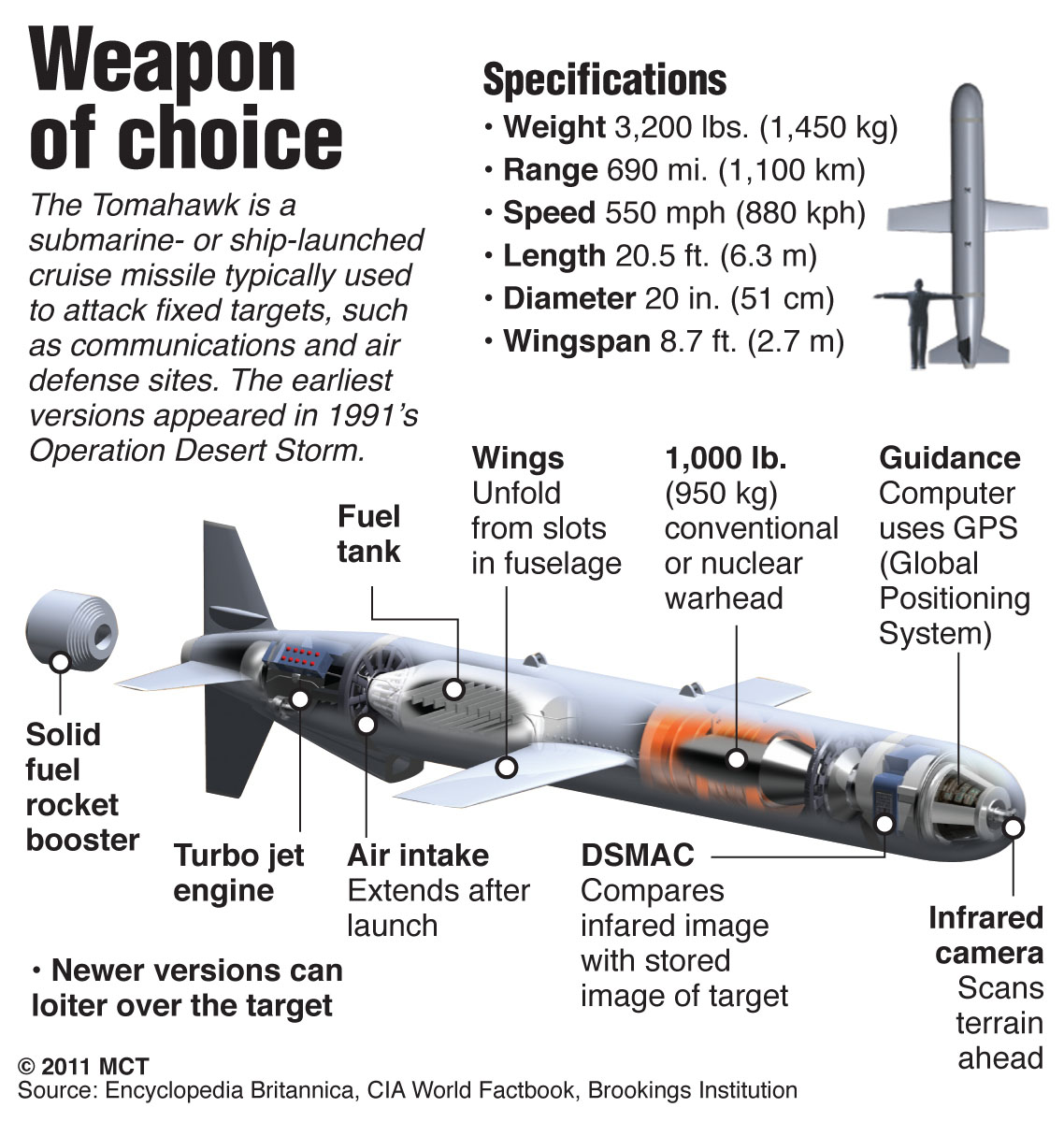
There’s also a Block Vb with an advanced JMEWS warhead capable of bunker-busting penetrating strikes on underground missile silos and WMD facilities. Outside of the Gulf War, Tomahawks were used to attack Iraq several more times in the 1990s, against Bosnian targets in 1995, during NATO actions against Yugoslavia, and during the engagements against Afghanistan after 9/11. More recently, Tomahawks saw use in Libya as part of Operation Odyssey Dawn, ISIS in Syria experienced the effects of Tomahawks, and Syrian chemical weapons facilities used by despot Bashar Al-Assad were struck by Tomahawks in 2017. In 2024, both American and British forces launched Tomahawks against Houthi rebels after the rebel group attacked shipping lanes and US-flagged vessels in the Red Sea.
The Block V, according to UK Defence Equipment and Support, an arm of the Ministry of Defence, would have a longer range than the Block IV at up to 1,000 miles, and also has updated in-flight communications and target selection. WASHINGTON ― Australia plans to buy the latest version of America’s long-range Tomahawk land attack missile in a $985 million deal announced Thursday. The Tomahawk family of missiles includes a number of variants, carrying different warheads.

Tomahawks can launch from the Mark 41 vertical-launch systems aboard surface ships or from a submarine’s own vertical launchers or torpedo tubes. All told, the Navy deploys around 10,000 Tomahawk launchers, although only a fraction of that total at any given time actually carries cruise missiles. The United States Air Force (USAF) deploys an air-launched cruise missile, the AGM-86 ALCM. The Boeing B-52 Stratofortress is the exclusive delivery vehicle for the AGM-86 and AGM-129 ACM.
It is currently the US's main and only operational cruise missile and is well suited for deterring nations like China in the Sea of Japan, as well as in the East & South China Seas. Although subsonic, it has a top of the art navigation system, 'sells' relatively cheap and works well in combination with a wide range of missiles. The supersonic all-purpose SM-6 missile is one such example, which like the Tomahawk, also uses the same Mark 41 VLS (Vertical Launching System). Canberra has said the missiles would be fielded on its Hobart-class destroyers, enabling them to strike land targets at greater distances, with better precision. Variants of the Block V can change targets in flight and strike moving targets at sea. Missile Threat brings together a wide range of information and analyses relating to the proliferation of cruise and ballistic missiles around the world and the air and missile defense systems designed to defeat them.
US approves $250 million sale of Tomahawk cruise missiles to Australia Navy - Navy Recognition
US approves $250 million sale of Tomahawk cruise missiles to Australia Navy.
Posted: Wed, 17 Jan 2024 08:00:00 GMT [source]
The War Zone has collected the latest unit costs of these weapons to give readers a sense of just how much it is spending to arm its fleet. It should be stressed that these are the prices for just the individual weapons and the figures do not factor in any future spending on support services, modifications, upgrades, or past spending on the weapons' development. Although the Kalibr has a similar average travel range, the missile is prone to jamming and has no two way data sharing link.


No comments:
Post a Comment